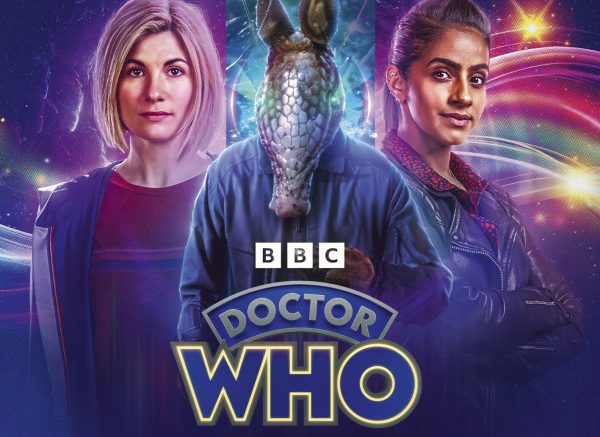
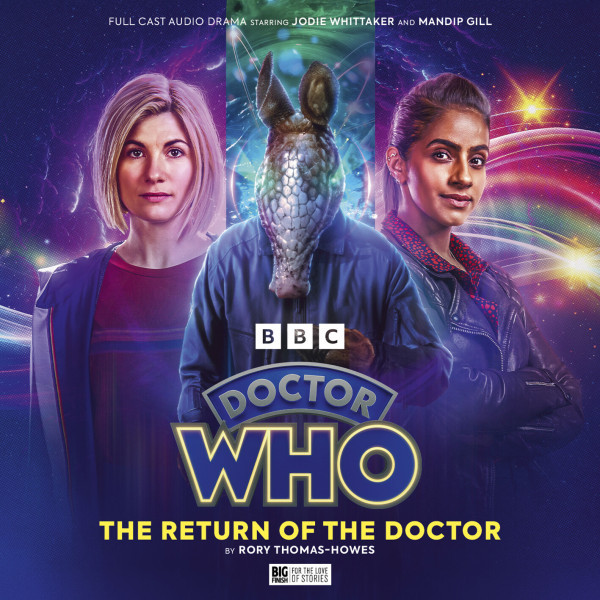
There’s a certain similarity in most of the reviews of The Return of the Doctor, the second story in the new Thirteenth Doctor audio series from Big Finish. Generally, you’ll read that while the first story, Vampire Weekend was a solid, well-anchored start, The Return of the Doctor is where the range starts to fly.
The reason you’ll read that more or less wherever you look is because… well, because while Vampire Weekend was a solid, well-anchored start, The Return of the Doctor is where the range starts to fly.
Down Among The Armadillos
An alien world, a defeated other-alien threat and a significant row between the Doctor and Yaz take up the first few minutes of run-time here, but such is the cleverness of Rory Thomas-Howes’ writing that within that period, we get a lot of what propels the whole of the adventure to its conclusion.
The Zaarians (sentient humanoid armadillo-folk, because we’re in an audio universe and why the heck not?) are initially saved from a bad-guy alien invasion by the Doctor, Yaz, and local guide Talpa (Will Kirk). Bish bash bosh, home to the Tardis and away in time for tea and Yahtzee.
Except here, Yaz’s uncertainties about the Doctor are first brought front and centre, and then exacerbated – too much of the Doctor’s world-saving plan, she believes, was dependent upon putting both Talpa at unspeakable risk.
That’s a clever note, carrying on from some of the on-screen friction in their first series together over the so-called “flat command structure” of the Fam, and it drives forward the rest of The Return of the Doctor, because as ever, with planets saved and casualties still recovering, the Doctor’s eager to be off, to be forgotten, to be very much not a part of the narrative.
In the ensuing row, the Doctor comes out with some familiar platitudes – she can’t save everyone, and it’s unfair on everyone to make them believe that she’ll be there whenever the Big Bad Things of the universe come calling. That way leads only to dependence, and to ultimate disappointment. And, you know…also to possible extinction while the universe is waiting on the Doctor’s return.
But Yaz is not satisfied and pushes her point. Things could go wrong, she argues. Things could fall apart – after all, things very often do. And so she puts her friendship and her travel with the Doctor on the line. Either they go back and make sure things actually do work out, or they’re done.
Cue the intensely traditional Tardis hiccup that means a plan to return in just a handful of heartbeats means they actually return decades later.
Later…
Annnnnd things have gone badly wrong in a way that should make Yaz feel smug, but obviously doesn’t, beeeecause now almost all the Zaarians want the Doctor executed for crimes against their species.
The joy of Thomas-Howes’ story is that while there is of course plenty of action and adventure and really wild things in the foreground – hatred of the Doctor appears to be spread like a plague, with actual physical symptoms including clouded eyes (nice metaphor, that – the inability to see things clearly or as they really are) – the meat of the story is embedded in whether or not suspicion of the Doctor’s motives and methods might not actually be entirely valid.
We’ve heard similar refrains throughout at least the course of New Who – Davros called the Tenth Doctor the man who turned his friends into weapons and kept running, never looking backward because he dared not. That same Doctor later admitted that he had gotten clever, and used people to fire the guns he himself would never fire. Even Amy Pond confronted the Doctor with the notion that if he didn’t save people, there was no point to him.
The Nature of Thirteen
This Thirteenth Doctor riff on the accusation feels especially subtle, but such is the nature of both the Thirteenth Doctor generally – bouncy, flouncy, let’s wave a sonic screwdriver around and have a custard cream, Fam! – and the somewhat specious nature of her reasons for running off at the start of this adventure, that it hits home a little harder, perhaps because it sounds in this incarnation like she especially wants to be done with all the “peopley” business as soon as the immediate focus of saving the world is done and dusted.
That means that throughout the course of The Return of the Doctor, we the listener, along with Yaz and the Zaarians, begin to wonder if in fact we’ve just been swept up in the energy and nose-scrunches of the whole thing, and whether there’s something more brittle about this Doctor’s methods than those to which we (unlike Yaz and the Zaarians) have grown accustomed. And whether that makes following her into battle especially dangerous – again, a thought that underscores an on-screen riff when her plan to defeat the Cyber-drones comes to absolutely nothing and leads to the deaths of some of those she gets to fight by her side.
So the construction of the underlying plot here is a real triumph on the part of Thomas-Howes, and both Jodie Whittaker and Mandip Gill play the stretching out of their characters’ relationship with a degree of subtlety rarely demanded of them in their on-screen run. It’s dangerously thin ice for a Doctor and her companion, and the two skate it like the professionals they are.
Twists and Heartbreak
The twist at the end of the story which leads to its inevitable dark conclusion is predictable once a particular event has taken place, and the pivotal event, involving two of the remaining friendly Zaarians who help the Doctor, Azaan and Vashir (Charlie Kelly and Belinda Stewart-Wilson respectively) is actually more heart-wrenching than the ending, although when it comes, the ending drives home the story’s central questions with a good deal of force.
More emotionally complex than Vampire Weekend because it carries less of the burden or reinventing the Thirteenth Doctor’s world in audio, The Return of the Doctor is both fun, engaging, dramatic, occasionally heartbreaking, and food for deeper thought about quite how the Doctor as an entity and this incarnation in particular conduct themselves as they go zipping up and down the timestream.
As in Vampire Weekend, there’s a good deal of sinister whispering about the Doctor’s nature, her relationships and her ability to cope with both what she has and what might well be coming for her, which begins to feel like a developing theme of her first series of audio adventures.
Addressing the Critics
The Return of the Doctor is a clever, heartfelt story that in a sense flirts with some of the real-world criticism of the Thirteenth Doctor’s era online – the seemingly cavalier attitude to the people who stand next to her (and even, occasionally, in her place) and the lack of any deep personal involvement with the people whose lives she re-writes in particular (an element of the era that was famously brushed off on-screen as her being “still quite socially awkward” when Graham almost asks outright for some reassurance about his health).
It’s a brave thing to tackle in the first place, and in less skilled hands, it could have backfired horribly, collapsing into irresolute mush and special pleading. Thomas-Howes never lets it do that, and the whole cast, (Whittaker, Gill and Kirk especially) rise wonderfully to the challenge of the tightrope tango the script demands.
That means you get a Thirteenth Doctor story that works on many levels at once, and on the one most critical to its success, everybody meets its challenges squarely and makes them sing.
That’s not a bad thing to achieve in just the second story in the range, and it’s likely that The Return of the Doctor will remain a high spot of this first series – and possibly of the range as a whole. Tony Fyler

If you like what we do and want to help us keep the lights on and the podcasting mics warm, we’d appreciate it if you bought us a cup of coffee


Be the first to comment on "Doctor Who: The Thirteenth Doctor: The Return of the Doctor – Written by Rory Thomas-Howes & Starring Jodie Whittaker & Mandip Gill (Big Finish)"